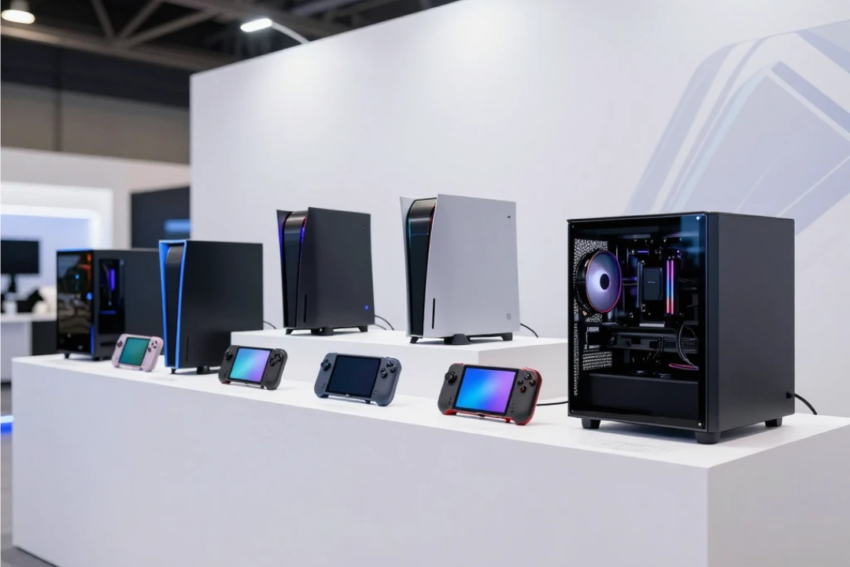
Introduction
The gaming industry is experiencing a major technological transformation in 2026. New hardware, artificial intelligence, advanced graphics, cloud gaming, virtual reality, faster networks, and portable gaming devices are changing how games are created and played.
The latest gaming technology innovations in 2026 are helping developers create larger and more detailed game worlds while giving players better performance, faster loading, realistic graphics, and more immersive experiences. At the same time, gaming is becoming more accessible through handheld devices and cloud-based platforms.
Understanding these innovations is important for gamers who want to upgrade their setups and for anyone interested in the future of interactive entertainment.
What Is Gaming Technology?
Gaming technology refers to the hardware and software used to develop, distribute, and play video games.
It includes:
- Gaming PCs
- Consoles
- GPUs
- CPUs
- SSDs
- Gaming monitors
- Controllers
- VR headsets
- Cloud gaming
- AI tools
- Game engines
- Online gaming networks
In 2026, these technologies are increasingly connected. A modern gaming experience can involve local hardware, cloud services, AI systems, digital stores, online multiplayer, and social platforms.
1. Artificial Intelligence Is Changing Gaming
Artificial intelligence is one of the biggest innovations affecting the gaming industry.
AI is being used in both game development and player-facing features.
Developers can use AI to assist with:
- Game testing
- Animation
- Dialogue
- Asset creation
- Prototyping
- Quality assurance
- Player behavior analysis
These tools can automate repetitive tasks and help development teams experiment with ideas more quickly.
Smarter NPCs
AI can also improve non-player characters.
Traditional NPCs often follow predefined rules. More advanced AI systems can allow characters to react more dynamically to player actions.
This can make game worlds feel less predictable and more interactive.
2. AI-Powered Graphics
AI is increasingly important for gaming graphics.
Modern graphics technologies can use AI-based methods for:
- Image upscaling
- Frame generation
- Image reconstruction
- Performance optimization
These technologies can allow games to produce higher-quality images while maintaining playable frame rates.
Why AI Graphics Matter
High-resolution gaming can place significant demands on GPUs.
AI-assisted rendering can help developers balance visual quality and performance.
This is particularly important for demanding 1440p and 4K gaming.
3. Next-Generation GPUs
Graphics processing units remain one of the most important parts of gaming technology.
Modern GPUs are designed to handle:
- High-resolution gaming
- Ray tracing
- Advanced lighting
- Detailed textures
- Complex visual effects
A powerful GPU can significantly improve gaming performance.
However, gamers should balance GPU performance with the CPU, monitor, and target resolution.
4. Ray Tracing and Realistic Lighting
Ray tracing has become a major graphics technology.
It can simulate the behavior of light to produce more realistic:
- Reflections
- Shadows
- Lighting
- Global illumination
This can make game environments look more realistic and cinematic.
The main challenge is performance. Advanced lighting effects can require substantial GPU resources.
AI-assisted rendering technologies are helping address some of these performance challenges.
5. SSD Storage and Faster Game Loading
Modern games are becoming increasingly large.
Fast SSD storage helps systems load game files more quickly.
Benefits include:
- Faster startup
- Shorter loading screens
- Faster asset streaming
- More responsive systems
SSD technology is especially important for open-world games that constantly load new environments.
As game worlds become larger and more detailed, storage performance will remain important.
6. Cloud Gaming
Cloud gaming is changing how games can be accessed.
Instead of running an entire game locally, supported games can run on remote servers and stream gameplay to a player’s device.
Potential benefits include:
- Lower local hardware requirements
- Access across multiple devices
- Quick game access
- Greater portability
Cloud Gaming Challenges
Cloud gaming depends on reliable internet connectivity.
Important factors include:
- Download speed
- Upload performance
- Latency
- Network stability
- Server availability
A strong internet connection can significantly improve the experience.
7. Handheld Gaming Innovation
Portable gaming is becoming increasingly important.
Modern handheld gaming devices can provide performance that was once limited to larger systems.
Features can include:
- High-resolution screens
- Powerful processors
- Integrated graphics
- Fast SSD storage
- Wireless connectivity
- Advanced controls
Handheld gaming allows users to play demanding titles in more locations.
Battery Life Is Critical
The biggest challenge for portable gaming hardware is balancing performance with battery life.
More powerful processors can consume more energy.
Future handheld devices will likely focus on improved efficiency as much as raw performance.
8. High Refresh Rate Displays
Gaming monitors are becoming faster and more responsive.
High refresh rates can provide smoother motion and improved responsiveness.
Important display specifications include:
- Refresh rate
- Response time
- Resolution
- HDR
- Adaptive sync
- Input latency
Competitive gamers may prioritize high refresh rates, while players who enjoy cinematic games may focus more on resolution and image quality.
9. Virtual Reality Gaming
Virtual reality continues to create immersive gaming experiences.
VR technology places players inside digital environments using specialized headsets and controllers.
Applications include:
- Games
- Fitness
- Training
- Simulations
- Social experiences
Future VR hardware may become lighter, more comfortable, and more powerful.
Better tracking and displays can also make virtual environments feel more natural.
10. Mixed Reality and Spatial Computing
Mixed reality combines digital content with the physical world.
Instead of completely replacing the real environment, mixed reality can place virtual objects within it.
Potential applications include:
- Gaming
- Education
- Fitness
- Entertainment
- Social experiences
Spatial computing may create new ways for players to interact with games beyond traditional screens.
11. Advanced Gaming Controllers
Controllers are also becoming more sophisticated.
Modern controllers can include:
- Haptic feedback
- Adaptive triggers
- Motion sensors
- Custom buttons
- Wireless connectivity
Haptic feedback allows players to feel different types of actions through physical vibrations and resistance.
This can make gameplay more immersive.
12. Spatial Audio and Gaming Headsets
Sound plays a major role in immersive gaming.
Modern gaming headsets can provide:
- Spatial audio
- Surround sound
- Noise cancellation
- High-quality microphones
- Wireless connectivity
Spatial audio can help players identify the direction of sounds.
This is especially useful in competitive multiplayer games where sound positioning can provide important information.
13. Faster Gaming Networks
Online gaming depends on network quality.
New networking technologies are helping improve multiplayer experiences.
Important developments include:
- Faster broadband
- Improved Wi-Fi
- 5G
- Better server infrastructure
- Improved routing
Low latency is particularly important for competitive games.
Even powerful gaming hardware cannot eliminate delays caused by a poor internet connection.
14. Cross-Platform Gaming
Cross-platform gaming allows players using different supported systems to play together.
This can increase multiplayer communities and provide greater flexibility.
Cross-platform services can also make it easier for players to move between devices while maintaining their digital gaming identities.
As gaming ecosystems become more connected, cross-platform support is likely to remain an important industry trend.
15. Advanced Game Engines
Game engines provide the foundation for modern game development.
They help developers create:
- 3D worlds
- Physics
- Lighting
- Animation
- Audio
- Characters
- Multiplayer systems
Modern engines are increasingly capable of supporting massive environments and detailed graphics.
AI-assisted development tools can also help teams automate certain repetitive workflows.
16. Gaming Content Creation
Gaming technology is also changing content creation.
Modern PCs and consoles can support:
- Live streaming
- Gameplay recording
- Video editing
- Social sharing
AI tools can assist creators with:
- Video editing
- Captions
- Highlights
- Voice enhancement
- Content organization
This makes it easier for gamers to turn gameplay into online content.
17. Mobile Gaming Technology
Mobile gaming continues to grow as smartphone hardware becomes more powerful.
Modern smartphones can support increasingly advanced games with:
- High-resolution graphics
- Fast processors
- Advanced GPUs
- High-refresh-rate screens
- Improved cooling
Cloud services can also expand the range of games available on mobile devices.
Benefits of Modern Gaming Technology
The latest gaming innovations provide several advantages.
Better Graphics
Advanced GPUs and rendering technologies create more realistic game worlds.
Faster Loading
SSDs reduce waiting times and improve game responsiveness.
Greater Immersion
VR, spatial audio, haptic feedback, and realistic lighting improve immersion.
More Accessibility
Cloud gaming and handheld devices make gaming available in more locations.
Smarter Experiences
AI can improve NPC behavior, personalization, graphics, and development.
Better Multiplayer
Improved networking and cross-platform support can create larger gaming communities.
Challenges of Gaming Innovation
Gaming technology also comes with challenges.
Expensive Hardware
High-end GPUs, gaming monitors, VR headsets, and PCs can be costly.
High Power Consumption
Powerful gaming systems can consume significant electricity.
Internet Dependence
Cloud gaming and multiplayer services require reliable networks.
Privacy and Security
Online platforms can collect user data and account information.
AI and Copyright
AI-generated game content raises questions about ownership, originality, and creative rights.
Rapid Technology Changes
Hardware and software can evolve quickly, making older products less competitive.
How Gamers Can Keep Up With Gaming Technology
Gamers do not need to purchase every new product.
Instead, identify the upgrades that provide the greatest improvement.
For example:
- Upgrade the GPU for better graphics.
- Upgrade the SSD for faster loading.
- Upgrade the monitor for higher refresh rates.
- Upgrade RAM for demanding multitasking.
- Improve networking for online gaming.
- Upgrade the headset for better audio.
Console users can focus on storage, displays, controllers, audio systems, and network improvements.
Future of Gaming Technology
The future of gaming is likely to combine AI, cloud computing, powerful hardware, immersive interfaces, and connected ecosystems.
AI could create more responsive characters and dynamic environments.
Cloud gaming could allow players to access supported games from a wider range of devices.
Handheld systems may become more powerful and efficient.
VR and mixed reality could create new forms of interactive entertainment.
Game development may also become more efficient as AI tools automate repetitive tasks.
Conclusion
The latest gaming technology innovations in 2026 are transforming almost every part of the gaming industry.
AI, powerful GPUs, ray tracing, SSD storage, cloud gaming, handheld devices, high-refresh-rate displays, VR, mixed reality, advanced controllers, spatial audio, faster networks, cross-platform gaming, and modern game engines are creating more immersive and flexible experiences.
The future of gaming will not be defined by one technology. Instead, multiple innovations will work together to create intelligent, connected, and highly immersive gaming ecosystems.
For gamers, the best strategy is to focus on meaningful improvements rather than simply chasing every new release. Choosing balanced hardware, reliable networking, quality displays, and useful accessories can provide excellent performance while keeping costs under control.
As gaming technology continues to advance, 2026 is shaping up to be an important year for the industry, bringing players closer to faster, smarter, and more immersive gaming experiences.